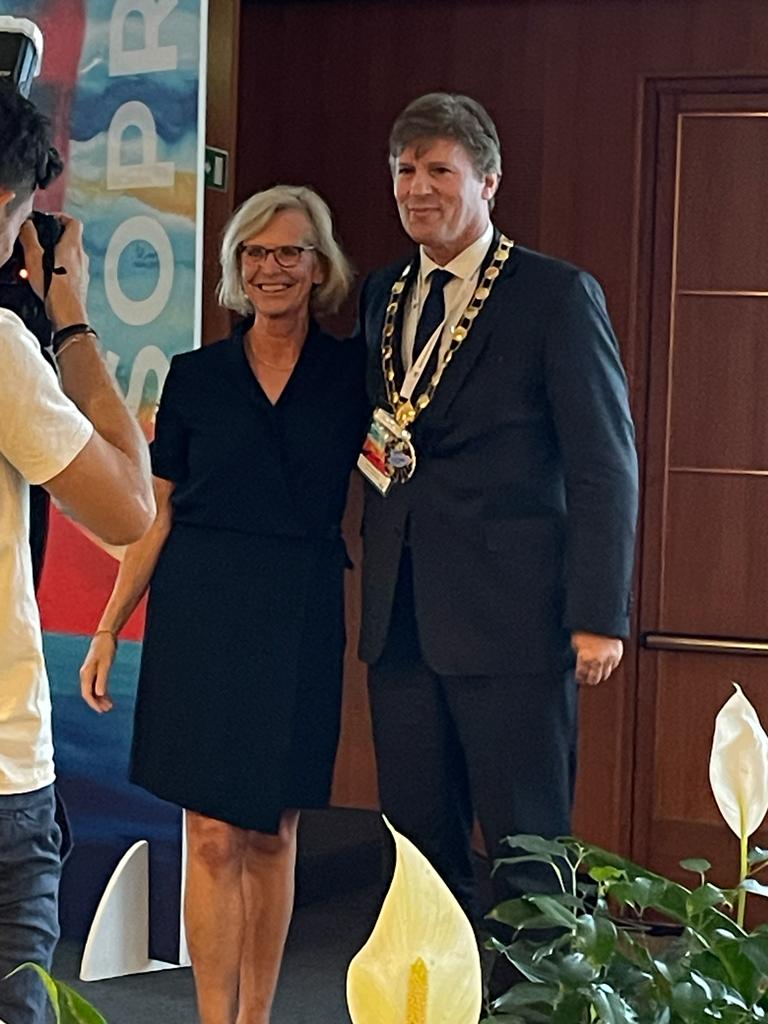
Dion Paridaens, President ESOPRS, samen met Eva Dafgard-Kopp, Past-president tijdens de 41st Annual Meeting van ESOPRS in Napels op 16 september 2023
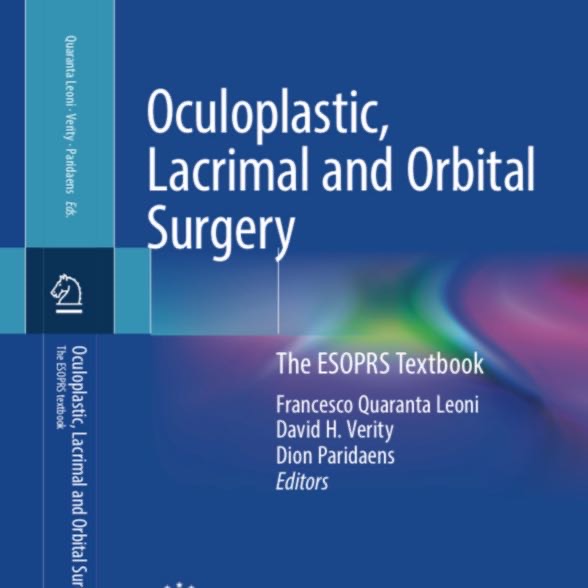
Op 16 september 2023 heeft Dr Dion Paridaens, oogarts in het Oogziekenhuis Rotterdam en het Erasmus MC, zijn Zweedse collega Eva Dafgard Kopp opgevolgd als President van de European Society of Ophthalmic Plastic & Reconstructive Surgery (E.S.O.P.R.S.). Hij zal deze prestigieuze rol gedurende twee jaar mogen invullen, waarna hij nog een jaar Past-President zal zijn binnen het bestuur van ESOPRS. De vereniging richt zich op educatie en nascholing van gespecialiseerde oogartsen/oculoplastisch chirurgen en telt honderden Europese leden, en tevens vele leden uit andere continenten. Jaarlijks is er een meerdaagse jaarvergadering dat de laatste jaren ongeveer 800 bezoekers uit de hele wereld trekt. Kennisoverdracht staat hierbij op de voorgrond. Ook is er gelegenheid voor jonge specialisten om een deelspecialistisch Europees (EBO-ESOPRS) examen af te leggen. Hiervoor werd door ESOPRS bestuurders, inclusief dr Paridaens, een boek samengesteld (ESOPRS Textbook on Oculoplastic, Lacrimal & Orbital Surgery) dat in november 2023 op de markt zal komen.
In zijn rol als President zal hij ESOPRS vertegenwoordigen bij jaarcongressen van zusterverenigingen in andere continenten (Amerika en Azie). Ook zal er geparticipeerd worden bij educatieve webinars.
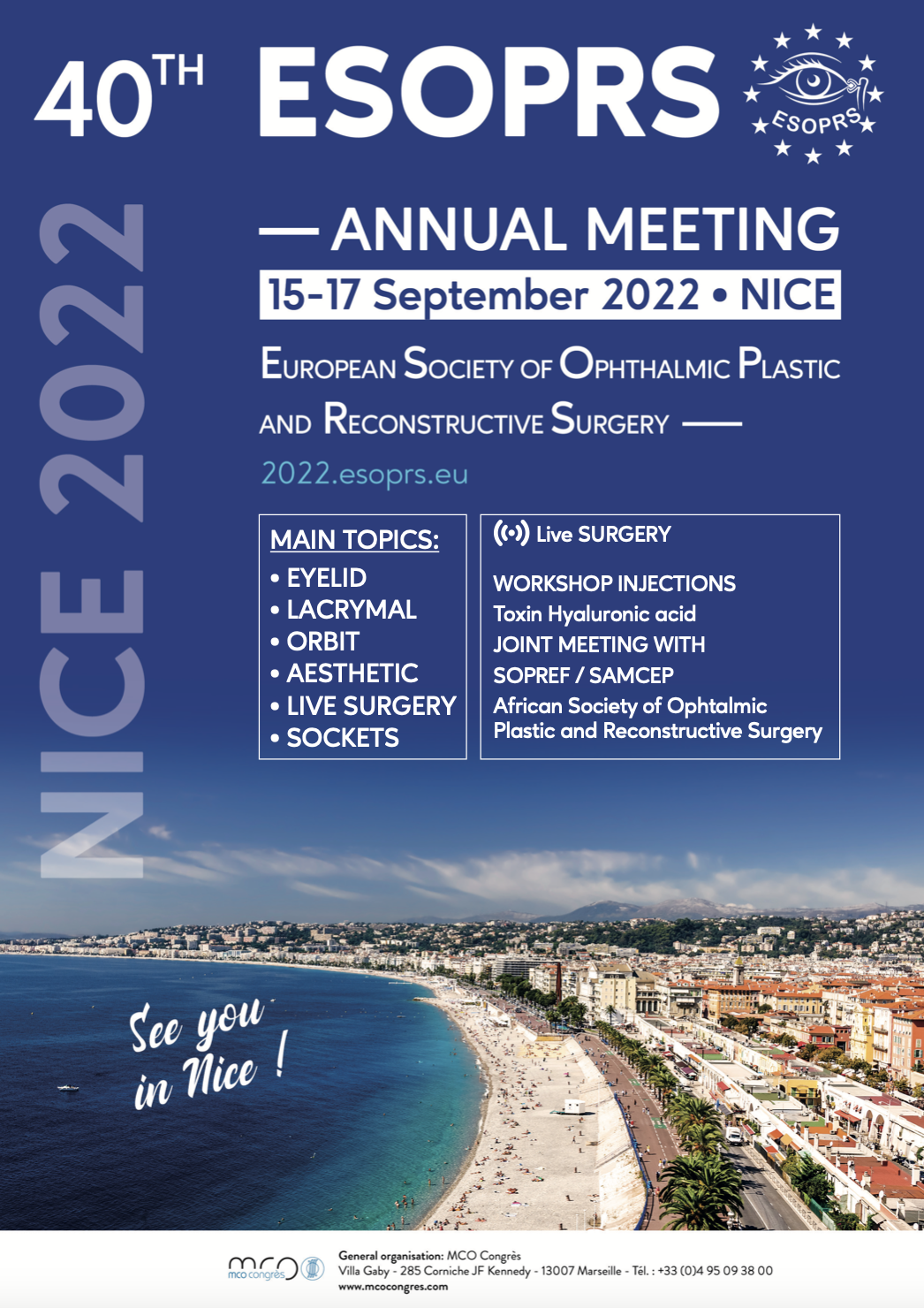
Bijzonder is dat hij -samen met zijn Amsterdamse collega Prof Peerooz Saeed en een team van Rotterdamse collega’s– de 42nd Annual Meeting van ESOPRS in Rotterdam zal gaan organiseren. Dit zal plaatsvinden in het congrescentrum de Doelen (september 12-14, 2024; zie www.esoprs.eu) en wordt ondersteund door het Congresburo (Erasmus MC)
Several years ago, three Executive Council members started the first preparations to write a textbook on Ophthalmic Plastic & Reconstructive Surgery to serve as teaching material for the upcoming EBO ESOPRS examination, which will start in September 2023. In addition, it could serve as a reference book.
The ESOPRS book will have 7 sections, each with varying numbers of chapters, focussing on the history of ESOPRS, functional eyelid disorders, cosmetic oculofacial surgery, lacrimal disorders, socket disorders, orbital disease, thyroid eye disease. The editors/authors (Francesco Quaranta Leoni (Villa Tiberia Hospital, Rome), David Verity (Moorfields Eye Hospital, London) and Dion Paridaens (Rotterdam Eye Hospital & Erasmus MC, Rotterdam)) and other authors have completed the work in May, and hope that Springer will publish the ESOPRS book (2 volumes, approx 1200 pages) in the fall of 2023.
The Editors hope and expect publication of the ESOPRS Textbook in the Fall of 2023
In September 2023 hoopt Dr Dion Paridaens, oogarts in het Oogziekenhuis Rotterdam en Erasmus MC, zijn collega Dr Eva Dafgard-Kopp op te volgen als President van de European Society of Ophthalmic Plastic & Reconstructive Surgery (E.S.O.P.R.S.). Deze dynamische beroepsvereniging richt zich op kennisoverdracht op het gebied van oculoplastische, traanweg en orbita chirurgie. Behalve de Europese en niet-Europese leden, met name gespecialiseerde oogartsen, komen ook vele specialisten en jonge artsen naar de jaarvergaderingen die telkens op andere Europese locatie worden gehouden. Daarnaast worden educatieve webinars georganiseerd, vaak samen met Amerikaanse of Aziatische zusterverenigingen. Paridaens is vanaf 2014 tot 2022 Secretaris geweest van ESOPRS en is vanaf 2022 de gekozen President-Elect. In deze periode is er een EBO-ESOPRS examen voor jonge oculoplastische specialisten gerealiseerd dat in Napels in September zal plaatsvinden. Samen met zijn collega’s Quaranta-Leoni uit Rome en Verity uit Londen is hij Editor van een uit twee delen bestaand ESOPRS leerboek over oculoplastische, traanweg en orbita chirurgie (uitgeverij Springer), dat hopelijk in het najaar op de markt zal komen.
Het Presidentschap duurt twee jaar, waarna er nog een jaar een rol als Past-President in het verschiet ligt.
Paridaens zal met steun van zijn Rotterdamse team en collega van het Amsterdam UMC, Prof Saeed, volgend jaar september de meerdaagse Annual Meeting van de ESOPRS in Rotterdam organiseren (12-14 september 2024).
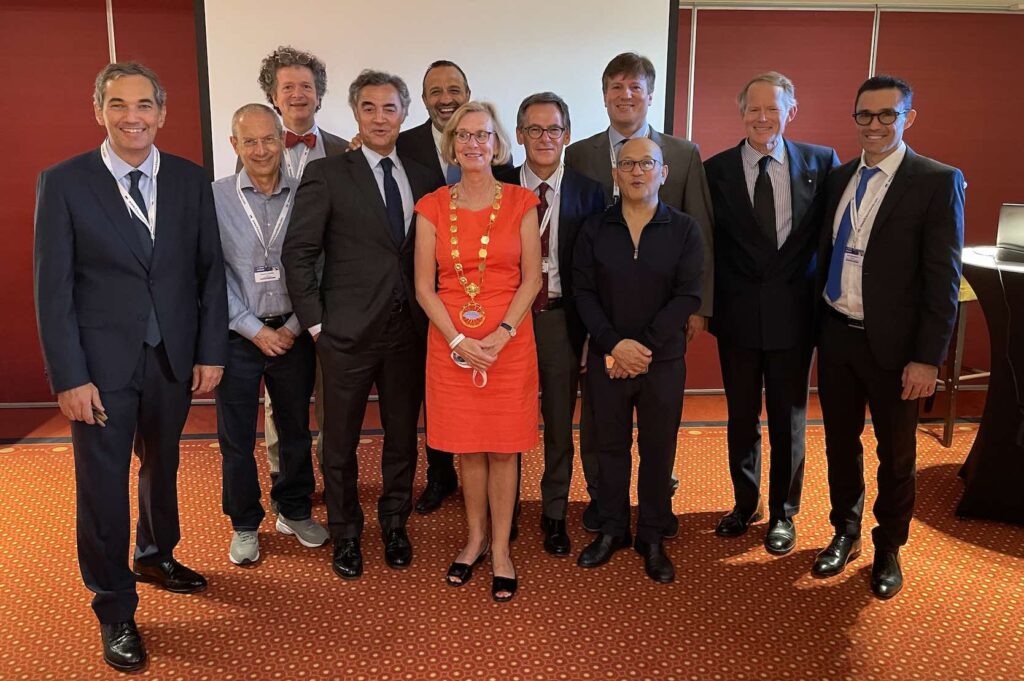
Foto: Het bestuur van de European Society of Ophthalmic Plastic & Reconstructive Surgery (E.S.O.P.R.S.) tijdens de jaarvergadering in Nice in september 2022. Centraal staat de President van ESOPRS, dr Eva Dafgard-Kopp (Zweden). 4e van rechts: Past-President Francesco Quaranta-Leoni (Italie), 3e van rechts (boven) Secretaris en President-Elect Dion Paridaens, 2e van rechts Penningmeester David Verity (Londen)
Dion Paridaens (Rotterdam Eye Hospital & Erasmus MC), Peerooz Saeed (Amsterdam UMC) supported by local team including Ronald de Keizer, Gijsbert Hotte, Sodaba Khatab (Rotterdam Eye Hospital), Femke Paridaens and Marie-Louise Bot (Het Congresburo Erasmus MC)
In 2024 the Annual Meeting of ESOPRS will be organized in Rotterdam, the Netherlands.
Tired look, Dr Dion Paridaens explains the surgical options..
In the cosmetic eyelid surgery practice of the ELZA clinic in Zurich and the Focusclinic of the Rotterdam Eye Hospital I see many clients who are keen to have an upper or lower eyelid correction. Most have a mild to moderate degree of skin excess, some even severe. Smokers often present themselves with festoons: a skin fold, sometimes filled with moisture, which hangs like a kind of bag at the bottom of the lower eyelids. Eyelids may also exhibit excess fat, especially noticeable in overweight or well-known dermatochalazis (skin excess due to loss of elastin fibers). Bags under the eyes or skin excess in the upper eyelids based on dermatochalazis contribute to a tired expression, which often does not reflect the energy status of the client.
Eyelid correction for bags under the eyes versus upper eyelid correction
Lower blepharoplasty (eyelid correction) is more complex from a surgical point of view and is less forgiving than upper eyelid correction, which is a very common procedure. Starting and unexperienced surgeons, especially those who have not had proper training in this field of cosmetic surgery through a fellowship program, will soon find out that cosmetic lower eyelid surgery is rather complex, sometimes – unfortunately – at the expense of a good result for their clients.
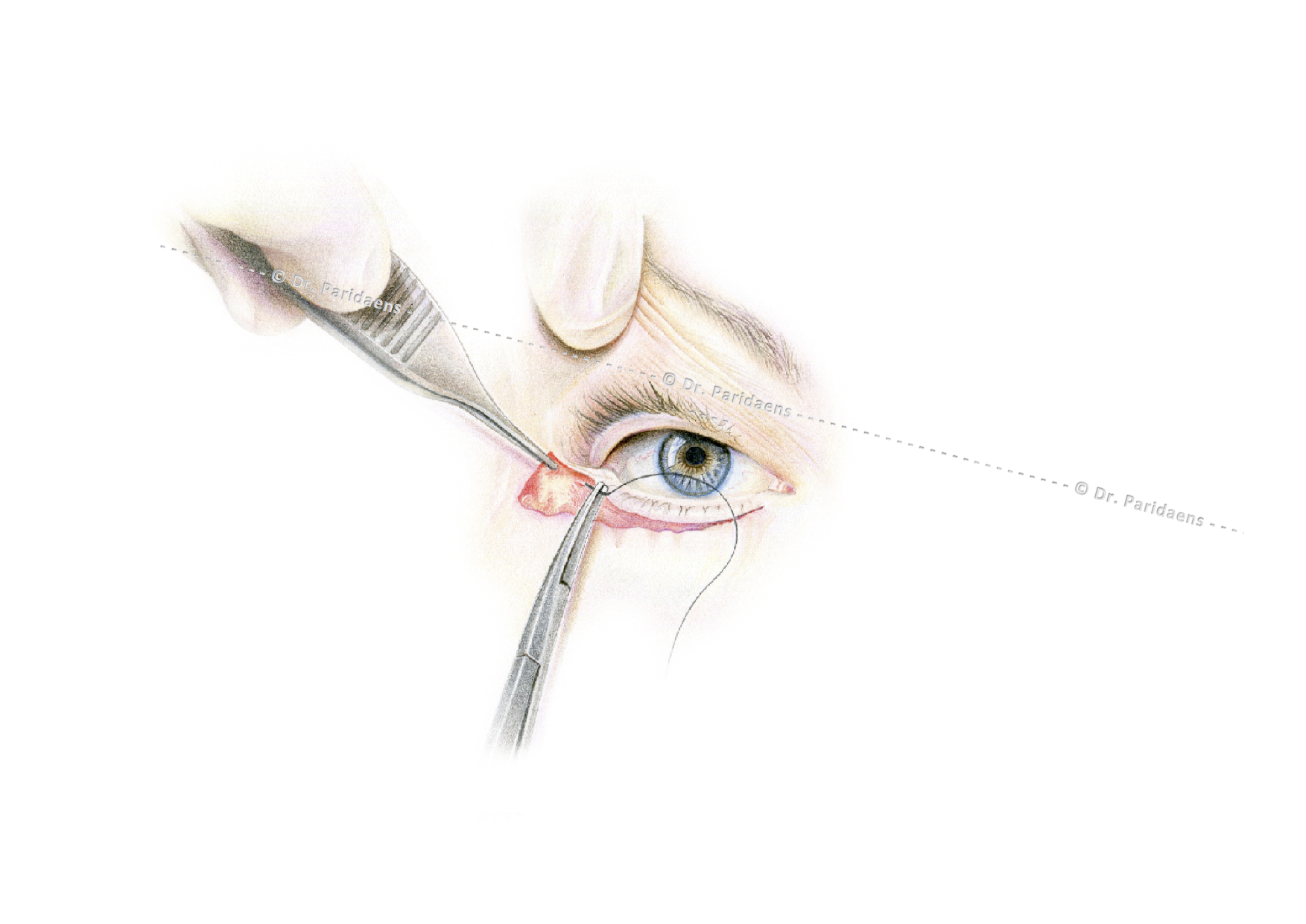
During lower eyelid correction with skin removal, canthopexy is an essential step: the eyelid is fixed with one or two (buried) stitches on the deeper tissues in the lateral eyelid angle to prevent a postoperative misalignment (eyelid retraction) causing an unnatural and undesirable appearance of whites of the eye under the iris. (Copyright Dr. D Paridaens, oculoplastic surgeon)
Why is lower eyelid correction more difficult than upper eyelid correction? The importance of canthopexy or canthoplasty in eyelid surgery!
First, the incisions in the upper eyelids are hidden in the natural crease of the upper eyelid. Only very close to the nose and to the side we can see a temporarily visible scar, which generally heals very well in the month after the operation and can be camouflaged in the initial phase with a foundation creme. In the lower eyelids the scars can be visible for weeks to months, the latter especially in smokers, despite the fact that they are placed in the relaxed skin tension lines (the natural skin lines that occur during the aging process) (this creates “hidden” as it were incisions “).
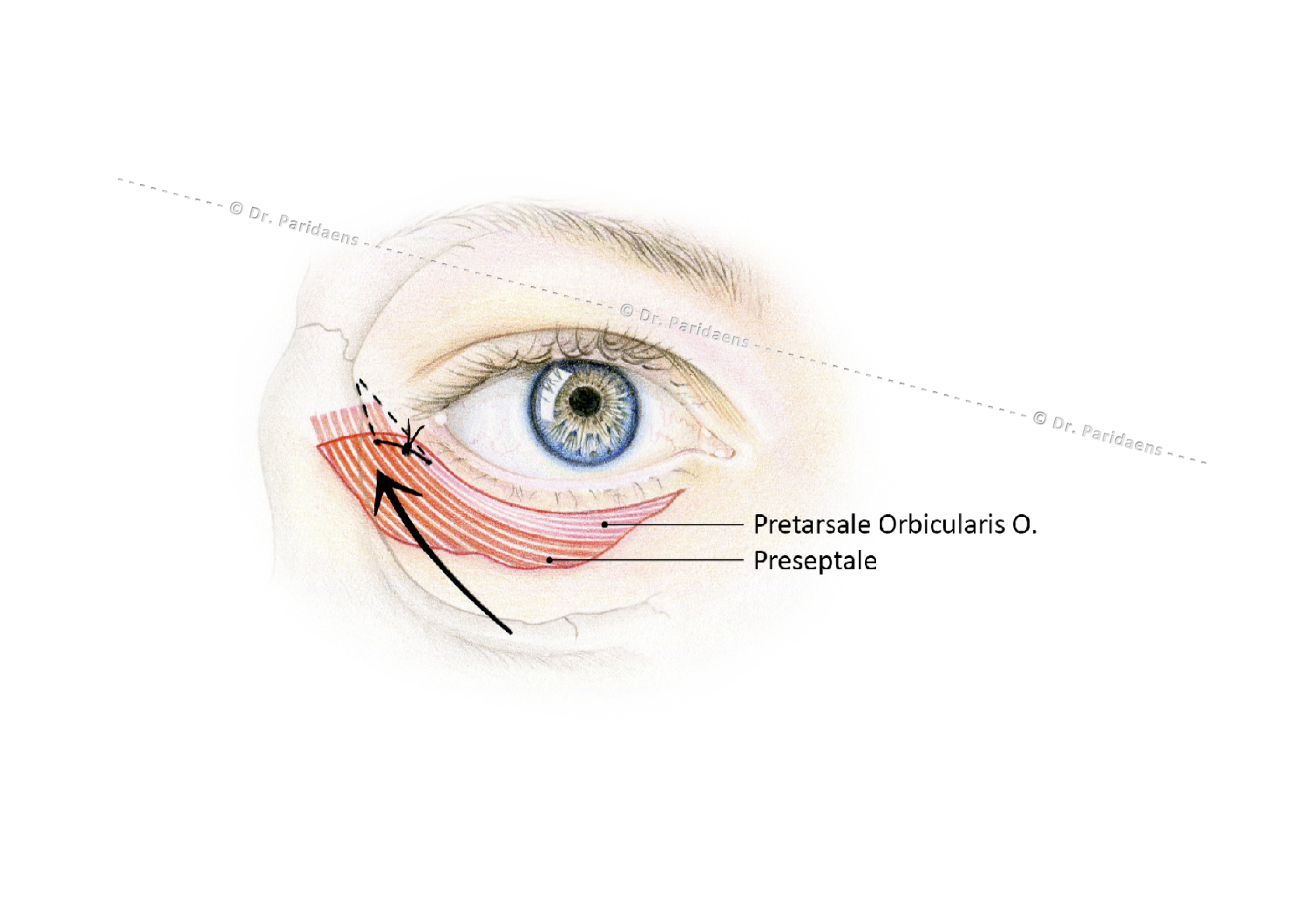
Fixation of the lower eyelid to the bone membrane with buried sutures and also deep sutures outside the lateral eyelid angle gives a good and natural result. As a result, the lower eyelid is neatly draped around the eyeball in a direction outwards and upwards (see arrow in the figure) and the gravity is neutralized. If these steps are not performed, this can lead to postoperative complications: incorrect position and unsightly retraction of the lower eyelids as well as dry eyes. (Copyright: Dr. D Paridaens, oculoplastic surgeon Illustration: Jessica Leenen)
Secondly, laxity of the lower eyelid may occur due to weakening and aging of the eyelid tissue and the ligaments that connect the eyelid to the bone. In addition, gravity pulls down the eyelid tissues. If the lateral part of the lower eyelid is not sufficiently shortened or fixed to the bone, any removal of excess skin can lead to an incorrect position of the eyelid (retraction or retraction of the lower eyelid), which can be enhanced by gravity. Therefore, the surgeon should try to prevent this by correcting the lower eyelids by means of 1. adequate canthopexy or canthoplasty (procedures to fix the eyelid to the bone) 2. limiting the amount of vertical skin removal during blepharoplasty, especially when the eye is relatively protruding (proptosis) or when the cheekbone is flat and 3. introduction of an outward / upward vector (force line) that counteracts the gravity vector by placing deeply supporting sutures in the soft tissues just outside the lateral corner of the eyelids.
Loeb-Hamra technique for eyelid correction: fat redistribution instead of removal!
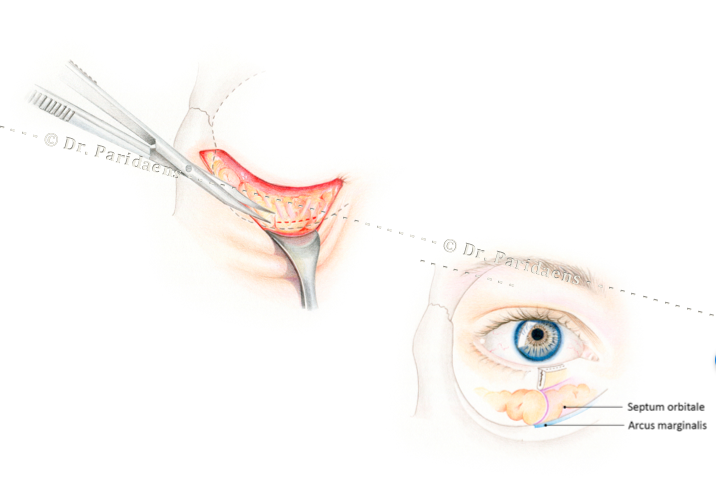
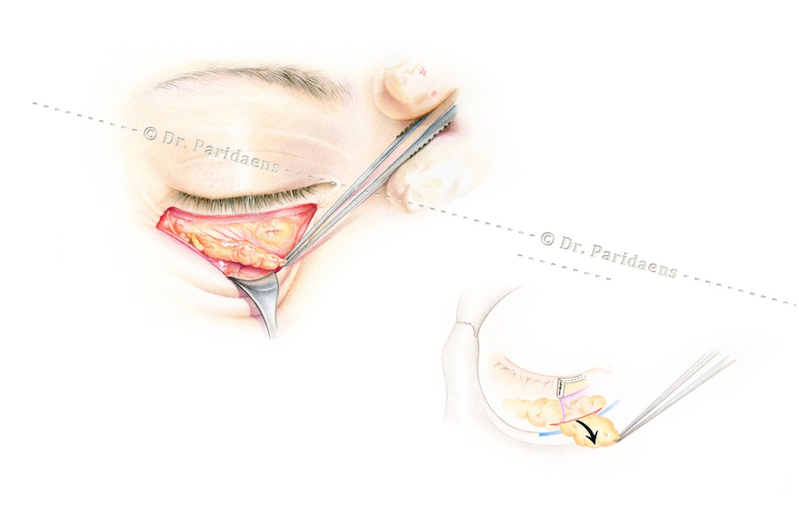
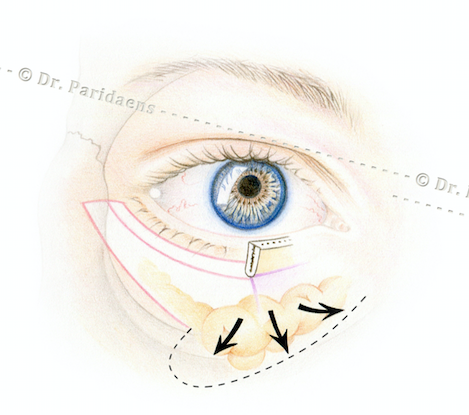
If there is too much fat in the lower eyelids while the tear trough or groove between the lower eyelid and the cheek is deep due to tissue loss resulting from aging (which enhances the effect of rings around the eyes), a fat redistribution is more logical than the alternative of removing it. This technique of re-using excess fat to a nearby location with a shortage of fat was described by Dr Loeb and also by Dr. Hamra. Here, after opening the lower eyelid through an opening under the lash line, an opening is made in the orbital septum, a thin connective tissue layer, whereby the fat can bulge forward. Then this fat can be put into a pocket above the orbital rim and placed under or above the periosteum layer above the cheek bone for filling of the tear trough. See the illustrations below.
After the opening of the lower eyelid, the orbital septum is visible behind which the fat excess is located. Near the orbital rim (arcus marginalis) the septum is opened which allows the fat to protrude. (Copyright Dr. Dion Paridaens, oculoplastic surgeon Illustration: Jessica Leenen)
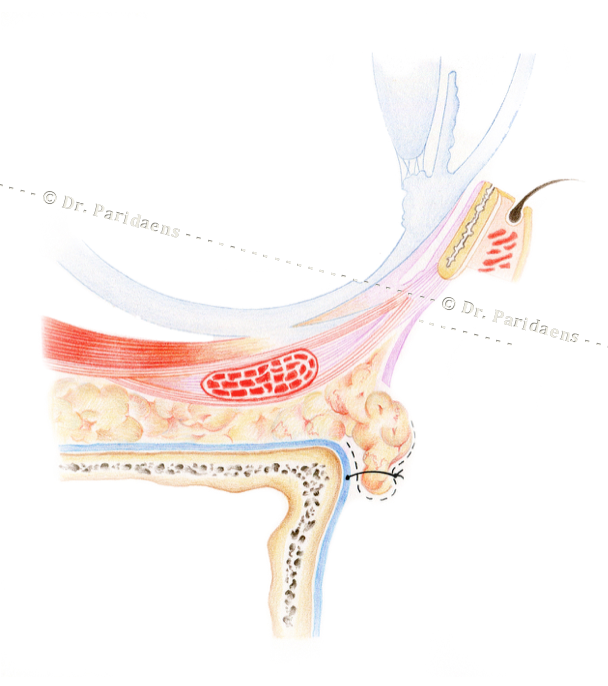
After the opening of the orbital septum, the surplus of fat – which causes the lower eyelid swelling – can be pulled through the opening and positioned over the orbital rim and put in a pocket above (or under) the periosteum layer above the cheek bone. As a result, the hollow groove is filled up while the fat acts as a natural filler. (Copyright: Dr. Dion Paridaens, oculoplastic surgeon Illustration: Jessica Leenen)
The excess of fat can be draped over the lower orbital rim in the direction necessary to fill the hollow groove below the lower eyelid. (Copyright: Dr. Dion Paridaens, oculoplastic surgeon Illustration: Jessica Leenen)
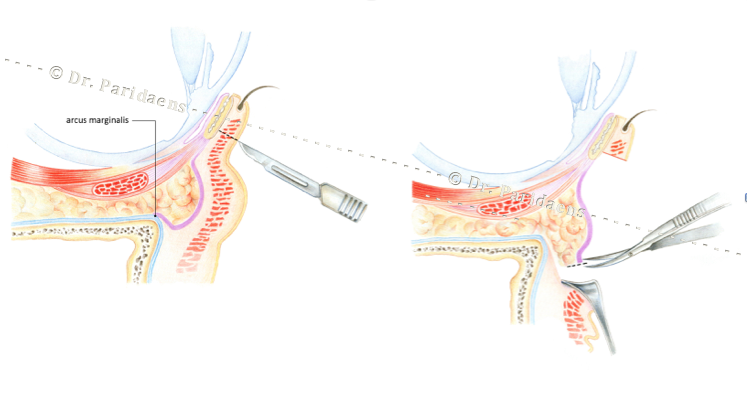
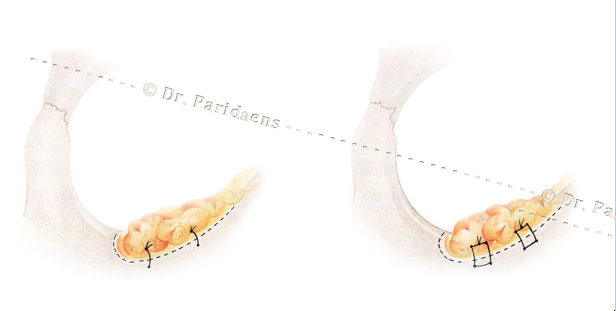
Left: the lower eyelid skin is incised at just below of the lash line. The skin and Orbicularis Muscle layer is pulled down so that the connective tissue (septum, purple) and the fat excess is visible. Right: the septum is opened at the level of the arcus marginalis, after which the fat can be draped downwards with a decrease of the eyelid swelling as a result. (Copyright: Dr. Dion Paridaens, oculoplastic surgeon Illustration: Jessica Leenen)
The excess of fat in the lower eyelid is used for filling the groove under the lower eyelid and fixed to the deep layer with single or mattress sutures. (Copyright: Dr. Dion Paridaens, oculoplastic surgeon Illustration: Jessica Leenen)
The fat surplus is draped over the eye socket. As a result, the hollow quarry is filled in, so there is less relief in the lower eyelid / cheek complex with improvement of the cosmetic (Copyright: Dr. Dion Paridaens, oculoplastic surgeon Illustration: Jessica Leenen)
Additional treatment after eyelid correction with laser or trichloroacetic acid (TCA peeling)
A well-executed lower eyelid correction generally gives a notable improvement in the appearance because of the reduction of the obvious swelling or excess of skin. However, one cannot expect that the aged skin will recover its original elasticity. Therefore, mild wrinkling or even mild surplus of skin may persist. Additional excision surgery can be hazardous as it might cause unsightly lower eyelid retraction, which may also cause functional problems such as tearing, diminished visual acuity or redness of the eyes. If the skin is wrinkled, it may be considered to treat the skin with laser or with trichloroacetic acid (TCA peeling) for an improvement of the cosmetic image. In the case of minor abnormalities, laser surgery or peeling can also be chosen instead of surgery.
Realistic expectations with regard to outcome of cosmetic lower blepharoplasty
In both upper and lower blepharoplasty it is important that clients are aware about the benefits, side effects and risks of the surgery. Adequate information prior to the surgery should prevent false expectations with regard to the outcome of surgery. If the expectations are not realistic, the outcome may be disappointing for the client even when this is objectively good. Fortunately, in our practice, the vast majority of well-informed and selected clients who have undergone a proper ophthalmologist correction are very satisfied with the result.
Dr Paridaens is an experienced eyelid and orbital surgeon. He is the current President-Elect of the European Society of Ophthalmic Plastic & Reconstructive Surgery (ESOPRS). In 27 years of surgery he performed more than 35,000 oculoplastic and orbital procedures. He operates 2 to 4 days per week with a focus on eyelids, brows, orbits and tear ducts. He is also a specialist in the field of botox treatments. ‘Obtaining a natural appearance’ is always the motto
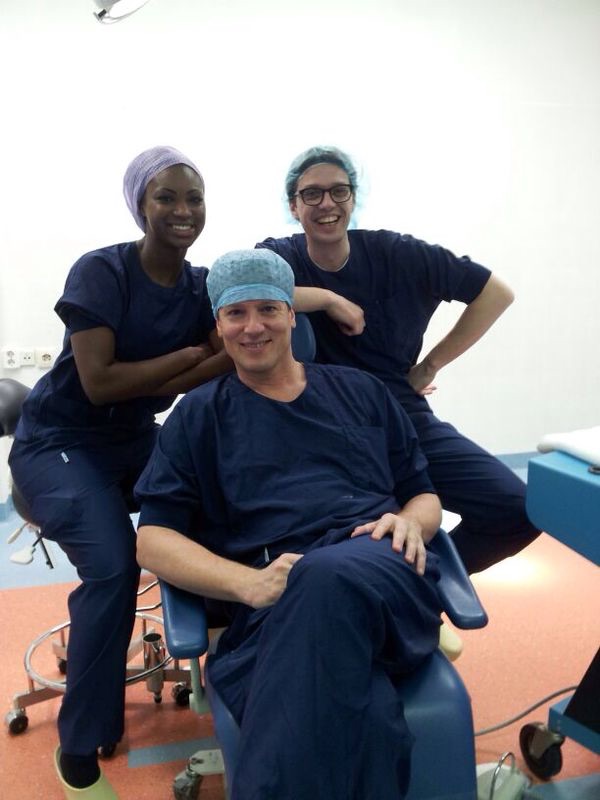
Oculoplastic team in the operating room with senior surgeon Dr Dion Paridaens (foreground), Dr Dianta Pinas (left behind) and Dr Ronald de Keizer (right behind)